Contents Restoration & Storage in Abilene
24/7 contents restoration & storage in Abilene and surrounding areas. IICRC-certified, insurance billing accepted. Call (325) 339-8723.
When a pipe bursts or a fire tears through a kitchen, the structure gets the headlines, but it is your belongings that carry the real weight of the loss. Furniture saturated with Category 2 water. Photo albums filmed with soot. Clothing that smells like smoke weeks after the fire is out. Contents restoration is the work of pulling those items back from the edge, using controlled cleaning, deodorization, and climate-stable storage, so that what can be saved is saved and what cannot is documented properly for your claim.
What Contents Restoration & Storage actually involves
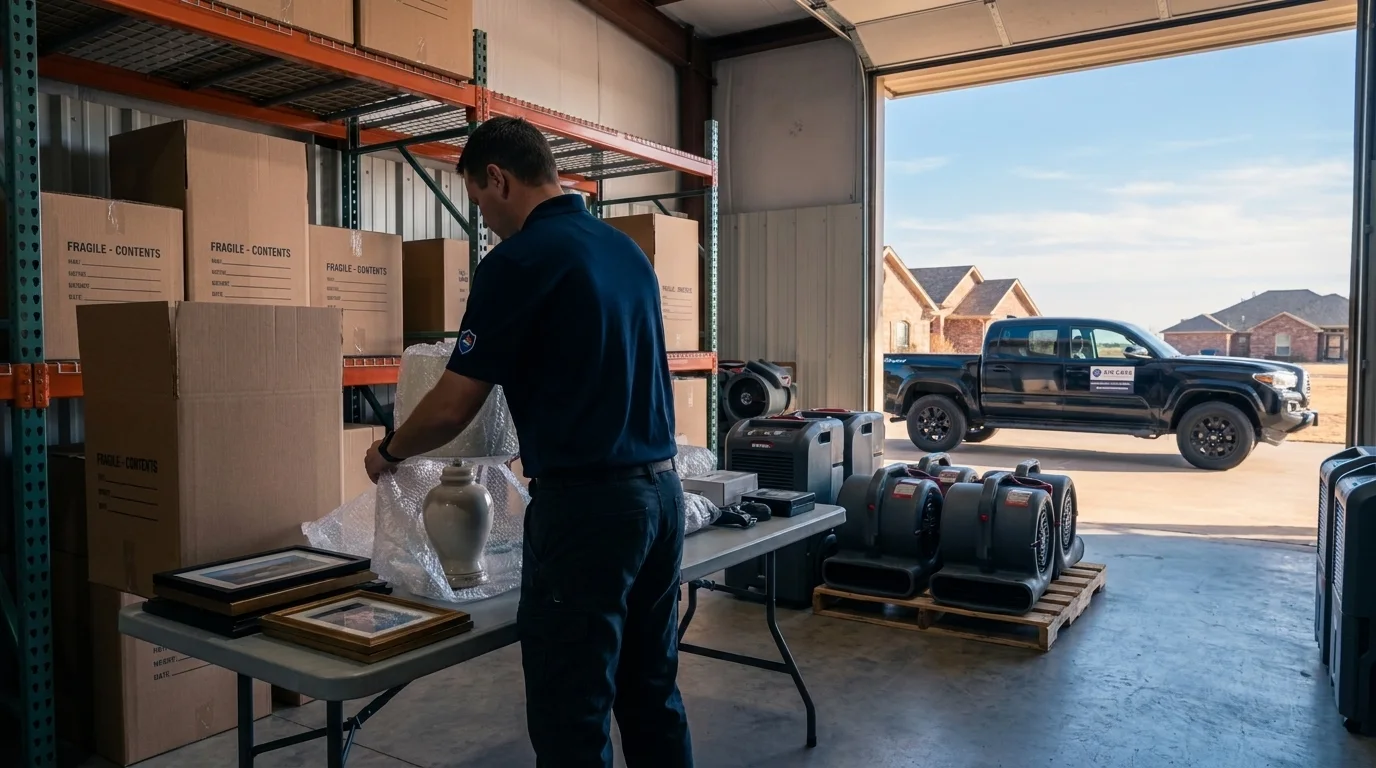
Contents restoration is not packing boxes and stacking them in a warehouse. It starts with a room-by-room inventory, typically photographed and logged before anything is moved, so every item has a documented condition at the time of loss. From there, restorable items are packed out to a climate-controlled facility where they are cleaned, deodorized, and dried under controlled conditions, away from the ongoing remediation work happening in your home.
The cleaning methods vary by material and contamination type. Ultrasonic cleaning tanks remove soot and smoke residue from hard surfaces, electronics housings, and porous ceramics without abrasion. Dry-cleaning and wet-cleaning protocols handle textiles based on fiber content and the category of water or smoke involved. Ozone chambers and hydroxyl generators address embedded odor in soft goods where surface cleaning alone will not reach the source.
Storage is held in a facility that maintains consistent temperature and humidity, which matters more than most people expect. A piece of wood furniture that dries too fast in an uncontrolled environment can check and warp permanently. Leather that sits in a damp trailer will begin to mold within days. The controlled environment is not a convenience, it is part of the restoration itself.
Timeline depends on the volume of items, the type of contamination, and the scope of repairs needed to the structure before redelivery. Partial pack-outs for a single-room loss may resolve in two to three weeks. Whole-house pack-outs tied to major reconstruction can extend several months, with items held securely until the home is ready to receive them.
Our process
-
On-site inventory and condition documentation. Before a single item leaves your home, every piece is photographed, logged by room, and assigned a condition code. This record becomes part of your insurance claim file and protects you if any dispute arises over pre-loss condition.
-
Triage and pack-out. Items are sorted into three categories: restorable, non-restorable (documented for replacement), and items the homeowner elects to retain as-is. Restorable contents are packed using appropriate materials, labeled by room of origin, and transported to the cleaning facility.
-
Cleaning and deodorization. Each item is cleaned using the method matched to its material and contamination type. Ultrasonic tanks, dry-cleaning, wet-cleaning, thermal fogging, and hydroxyl treatment are applied as needed. Items are not released from this stage until odor and contamination levels are within acceptable limits.
-
Climate-controlled storage. Cleaned items move into the storage facility, where temperature and relative humidity are monitored continuously. Items are stored by room and cross-referenced to the original inventory so redelivery can be organized room by room.
-
Redelivery and walk-through. When the structure is ready, contents are returned in room order. A walk-through confirms condition against the original inventory, and any items that did not restore to an acceptable standard are flagged for the adjuster’s review.
What separates a good contents response from a bad one
The most common failure in contents restoration is skipping the pre-move inventory. Without it, there is no baseline for condition at the time of loss, which creates disputes with adjusters and leaves homeowners without documentation for items that were damaged in transit or during cleaning. A thorough photo-and-log inventory before anything moves is not optional, it is the foundation of a defensible claim.
The second common failure is using a one-size cleaning method. Wet-cleaning a water-sensitive textile, or running a heat-sensitive electronic through a process it cannot tolerate, causes secondary damage that is often worse than the original loss. Operators who do this work correctly match the cleaning protocol to the item, not to what is fastest.
Insurance adjusters look for the inventory log, the condition codes, the cleaning method applied to each item, and the storage facility’s climate records. A well-documented contents pack-out moves through the claims process faster and with fewer disputes. Gaps in that documentation slow everything down and sometimes result in items being depreciated rather than restored.
What does Contents Restoration & Storage cost?
Typical costs for contents restoration and storage depend heavily on the volume of items, the type of contamination, and how long storage is required. Most homeowners pay somewhere in the following ranges based on the scope of the loss, and every loss is different. Air Care Restoration provides a written scope of work before any work begins, so you know exactly what is being done and why. Homeowners insurance typically covers contents restoration when the loss is caused by a covered peril, and Air Care Restoration works with all carriers to document the claim and bill directly.
| Scenario | Typical industry range |
|---|---|
| Single room, clean water, partial pack-out | $800 - $2,500 |
| Single room, smoke or soot contamination | $1,500 - $4,000 |
| Multi-room pack-out, water and smoke combined | $4,000 - $10,000 |
| Whole-house pack-out, major fire or flood | $10,000 - $30,000+ |
| Extended climate-controlled storage (per month) | $200 - $600 |
| Ultrasonic cleaning, hard goods and electronics | $500 - $2,500 |
Seasonal and regional considerations
Abilene’s climate creates a specific risk window for contents in storage. West Texas summers push ambient temperatures well above what uncontrolled warehouse space can manage, and the region’s periodic severe storms, including hail events and the occasional tornado, can create sudden whole-house losses where the volume of items needing pack-out is significant. Homes built in Abilene’s older neighborhoods, particularly those with pier-and-beam foundations, often have furniture and stored items at floor level that are the first things affected when plumbing fails or a storm drives water in through a crawlspace. Knowing what you are dealing with before the truck arrives matters here.
Service area
Air Care Restoration serves Abilene and the surrounding communities across the Big Country, including Sweetwater, Merkel, Clyde, Anson, and the broader Taylor and Jones County areas. The city-specific pages for each community link back here for the full process detail.
If your belongings are sitting in a damaged room right now, the clock on secondary damage is already running. Call Air Care Restoration at (325) 339-8723 to schedule your contents pack-out assessment and get a written scope before anything moves.
Frequently Asked Questions
Does homeowners insurance cover contents restoration and storage?
What is the difference between a non-restorable item and a restorable one, and who decides?
How does ultrasonic cleaning work, and which items is it used for?
How long can my belongings stay in storage, and what conditions are they kept in?
Why does smoke odor sometimes return in items that were cleaned and seemed fine at first?
Looking for the best contents restoration & storage company in Abilene?
Air Care Restoration provides licensed and insured contents restoration & storage in Abilene, TX and the surrounding area, and has served local property owners since 2026. Customers rate us 5.0 out of 5 stars across 22 Google reviews. We answer calls 24/7 — call (325) 339-8723 for immediate help.
Need Contents Restoration & Storage now?
We respond 24/7 across Abilene and surrounding TX cities.
Related Coverage
- Our Restoration Services
- Contact Air Care Restoration
- Contents Restoration & Storage in Albany
- Contents Restoration & Storage in Anson
- Contents Restoration & Storage in Baird
- Contents Restoration & Storage in Ballinger
- Contents Restoration & Storage in Bronte
- Contents Restoration & Storage in Brownwood
- Contents Restoration & Storage in Buffalo Gap
- Contents Restoration & Storage in Clyde
- Contents Restoration & Storage in Coleman
- Contents Restoration & Storage in Colorado City
- Contents Restoration & Storage in Comanche
- Contents Restoration & Storage in Early