For unattended death cleanup in Abilene, TX, call (325) 339-8723, the line for Air Care Restoration, an IICRC Certified Firm trained to the ANSI/IICRC S540 standard for trauma and biohazard scenes. That call comes after law enforcement or the medical examiner has released the scene, never before.
Finding an unattended death is disorienting, and most people have no idea what order things happen in or who is even allowed to touch anything. This guide walks through exactly that: what to do in the first hour, who in Texas is responsible for arranging cleanup, why it can’t be a regular cleaning crew, what insurance typically covers, and how long the home stays off-limits.
What should you do first if you discover an unattended death at home?
Call 911 immediately, leave the room exactly as it is, and do not attempt to clean, move, or disinfect anything until officials say the scene is released.
In Taylor County that usually means the Abilene Police Department or the Taylor County Sheriff’s Office responds first, and the Taylor County Justice of the Peace makes the official determination, which is standard practice across most Texas counties when there’s no on-call medical examiner. Until that happens, the room is part of an active investigation. Family members, neighbors, or a property manager near Abilene Christian University, Dyess Air Force Base, or anywhere else in town should stay out of the affected room, including hallways or carpets the area opens onto.
Once officials release the scene, that’s the moment to call a trauma and biohazard cleanup crew, not a maid service or a handyman.
Who is responsible for cleanup after a death in Texas?
Responsibility usually falls to whoever holds the property: the family or the estate’s executor for a private home, and the landlord for a rental unit once the space needs to be made safe again.
If the death happened in an owned home, the surviving family or the person named executor in probate can authorize and schedule cleanup even before the estate is formally settled; most biohazard crews only need the authorization of whoever has legal access to the property. If it happened in a rental, Texas landlord-tenant law generally puts the burden of restoring a habitable unit on the property owner, though a lease or the landlord’s insurance may shift some of that cost. Either way, it helps to loop in the estate’s attorney or the property manager early so there’s no confusion later about who approved the work.
What happens after you call a biohazard cleanup crew?
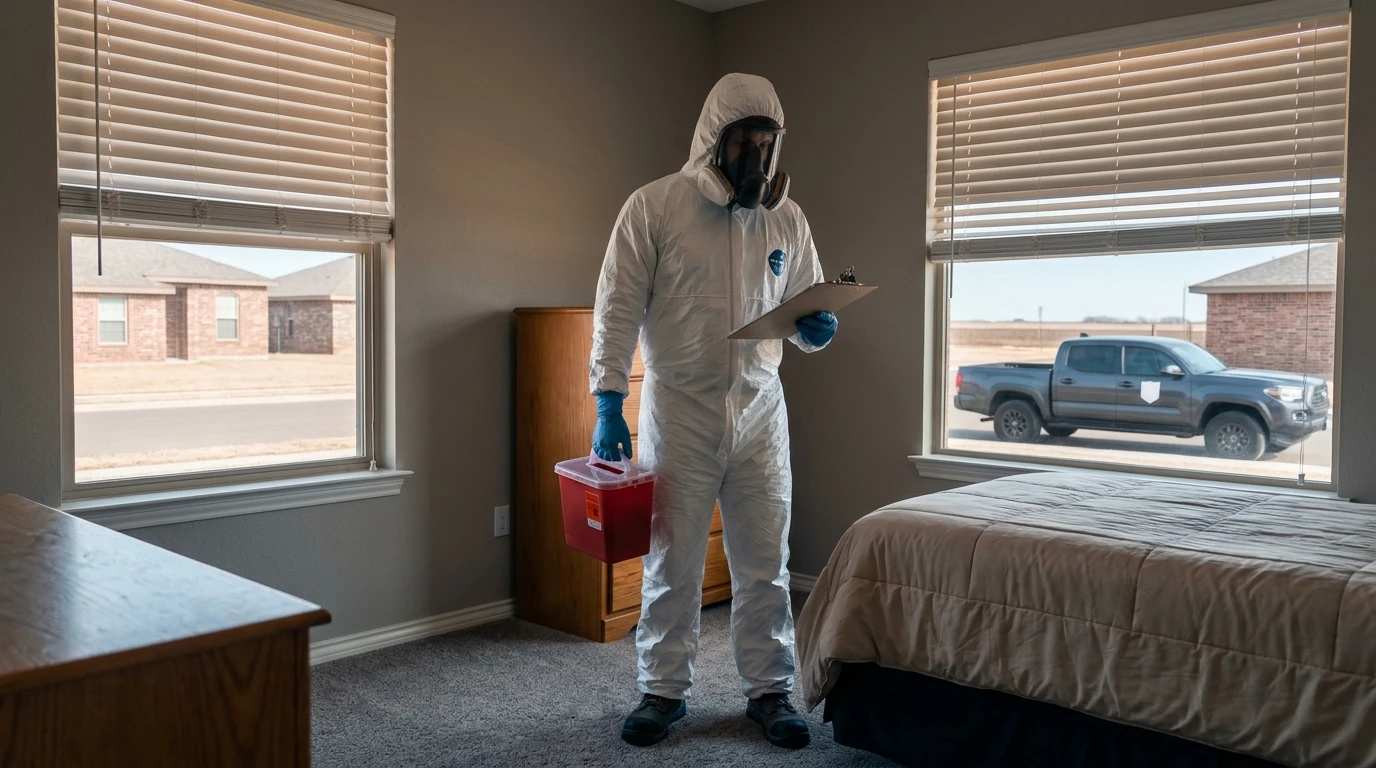
A trained crew arrives in full personal protective equipment, including a sealed suit, respirator, and double gloves, and begins with an assessment before touching anything.
The first phone call is usually short: the address, whether the scene has been released, and roughly how long the area went undiscovered, since that affects how far contamination may have spread into subfloor or wall cavities. On arrival, the crew documents the affected materials with photos for insurance purposes, sets up containment, and removes anything that can’t be safely decontaminated, usually carpet, padding, and sometimes subfloor sections, following OSHA’s bloodborne pathogens standard for handling and disposal. Hard surfaces get cleaned with EPA-registered disinfectants rated for biological contaminants. Our trauma scene cleanup and biohazard cleanup work both follow this same sequence, whether the job is a single bedroom or a larger area of the home.
Does homeowners insurance cover unattended death cleanup?
Many homeowners and landlord policies cover trauma and biohazard cleanup under vandalism, accidental discharge, or a named-peril clause, but the coverage, deductible, and limits vary a lot by carrier, so it’s worth calling the insurer directly before assuming either way.
According to the Insurance Information Institute, standard homeowners policies cover a defined list of perils, and whether a given policy treats biohazard remediation as one of them depends on the exact language. A written scope of work and photo documentation from the cleanup crew gives the adjuster something concrete to work from, which matters more than guessing at coverage ahead of time. For a rental, check whether the loss falls under the landlord’s commercial policy instead of a tenant’s renters policy.
How long does cleanup take, and when is the home safe again?
Most unattended death cleanups take one to three days, depending on how long the scene went undiscovered and how far contamination reached into flooring, walls, or subfloor.
A scene discovered within a day or two is often a contained job: affected materials removed, surfaces decontaminated, air quality checked. A scene that went unnoticed for a week or more usually means a larger scope, since porous materials absorb contamination the longer they sit, and odor becomes part of the job rather than an afterthought. Odor removal is the last step, not an extra, since lingering odor is often the clearest sign that contamination wasn’t fully addressed. See our odor removal page and our deodorization explainer for how that final phase works. A related read, our bio-hazard and trauma clean-up overview, covers the general process in more detail if you want the fuller picture.
An unattended death is hard enough without wondering whether the room is actually safe to use again. Call (325) 339-8723 once officials have released the scene, and a trained crew can walk through the scope, flag what insurance may cover, and get started the same day where scheduling allows.
About Air Care Restoration
This IICRC Certified Firm has served Abilene and the surrounding Big Country region since 2026, holding Texas Department of Licensing and Regulation license MRC2262 along with IICRC training that includes Trauma and Crime Scene Technician (TCST), Hazardous Substances Technician (HST), and Odor Control Technician (OCT) certifications. The team is available 24/7 and approaches biohazard and trauma scenes with full PPE, EPA-registered disinfectants, and discretion, following the IICRC S540 standard from the first phone call through final odor clearance.
Video Transcript
Finding an unattended death at home is overwhelming, and most people don’t know what to do first or who’s even allowed to help. Call 911 immediately, leave the room untouched, and wait for officials to release the scene before anyone cleans or disinfects anything. In Taylor County, police or the sheriff respond first, and the Justice of the Peace officially releases the scene before cleanup can begin. Responsibility usually falls to the homeowner, the estate’s executor, or the landlord, depending on whether the property is owned or rented. Once the scene is released, call a trained trauma and biohazard crew, never a maid service or handyman for a job like this. Your contractor arrives in full protective gear, documents everything with photos, and sets up containment before removing any contaminated materials. Affected carpet, padding, or subfloor gets safely removed, and hard surfaces are cleaned with EPA-registered disinfectants made for biological contamination. Many homeowners and landlord policies help cover this kind of cleanup, but coverage and deductibles vary, so check with your insurer directly. Most jobs take one to three days, and odor removal comes last, since lingering odor often means contamination wasn’t fully addressed. An unattended death is hard enough without wondering if the room is safe again. Call Air Care Restoration at (325) 339-8723 to schedule an assessment.